AI Crawler Control: Should Content Sites Block, Allow, or Price AI Bots?
A practical decision framework for content sites deciding whether to allow, block, monitor, or price AI crawler access.
Last updated
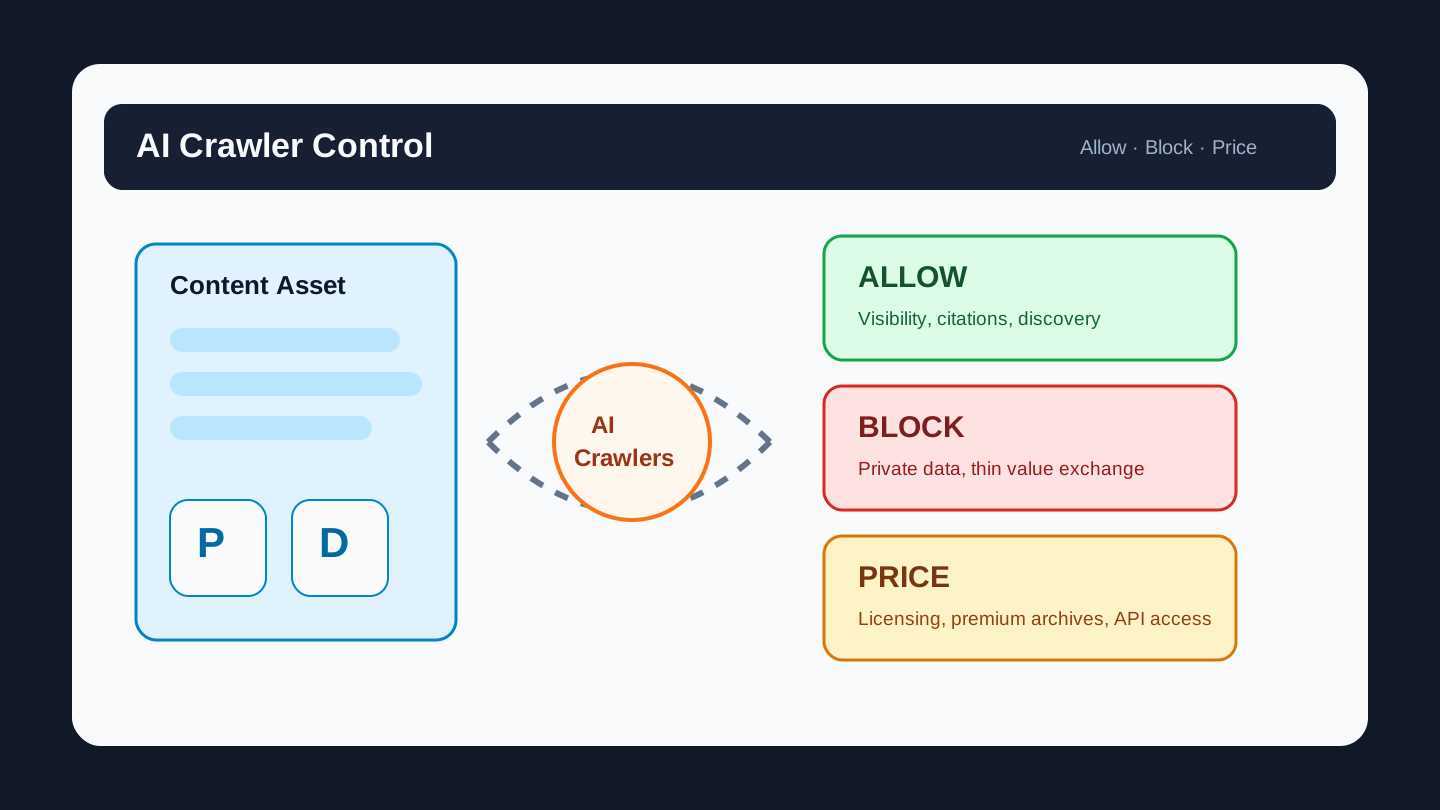
AI crawler control is becoming a real operating decision for content sites. The old bargain was simple: search engines crawled pages, showed snippets, and sent measurable traffic back. AI search breaks that bargain into several weaker signals: citations, brand mentions, answer summaries, training value, and sometimes very little referral traffic.
That does not mean every content site should block every AI bot. It means the crawler policy should match the content asset. A SaaS blog wants discovery. A paid research archive wants leverage. A documentation site wants accurate answers. A community forum may need consent and privacy controls before it needs visibility.
As of July 11, 2026, the practical question is no longer "AI bots: yes or no?" It is:
Which pages should be discoverable by AI systems, which pages should be protected, and what evidence would justify changing that policy?
The old crawl bargain is weaker
Traditional SEO treated crawling as the start of a traffic loop. A crawler found the page, the page entered an index, searchers clicked results, and analytics could show whether the content worked. The value exchange was imperfect, but visible.
AI answers make the exchange harder to read. A model or answer engine may use public web content to generate a response. The user may see a summary, a cited source, a brand mention, or no visible source at all. A page can influence the answer without receiving a click.
Cloudflare's Pay Per Crawl announcement made that tension concrete by framing AI crawler access as a relationship publishers may want to price, allow, or deny. Google Search Central also separates crawler roles: Googlebot is for Search indexing, while Google-Extended lets publishers express whether content may help improve Gemini Apps and Vertex AI generative APIs. Those are not the same control.
This distinction matters. Blocking the wrong crawler can reduce search visibility. Allowing every crawler can expose high-value content without measurable return. Treating robots.txt as a full business model can create false confidence.
Start by classifying the content
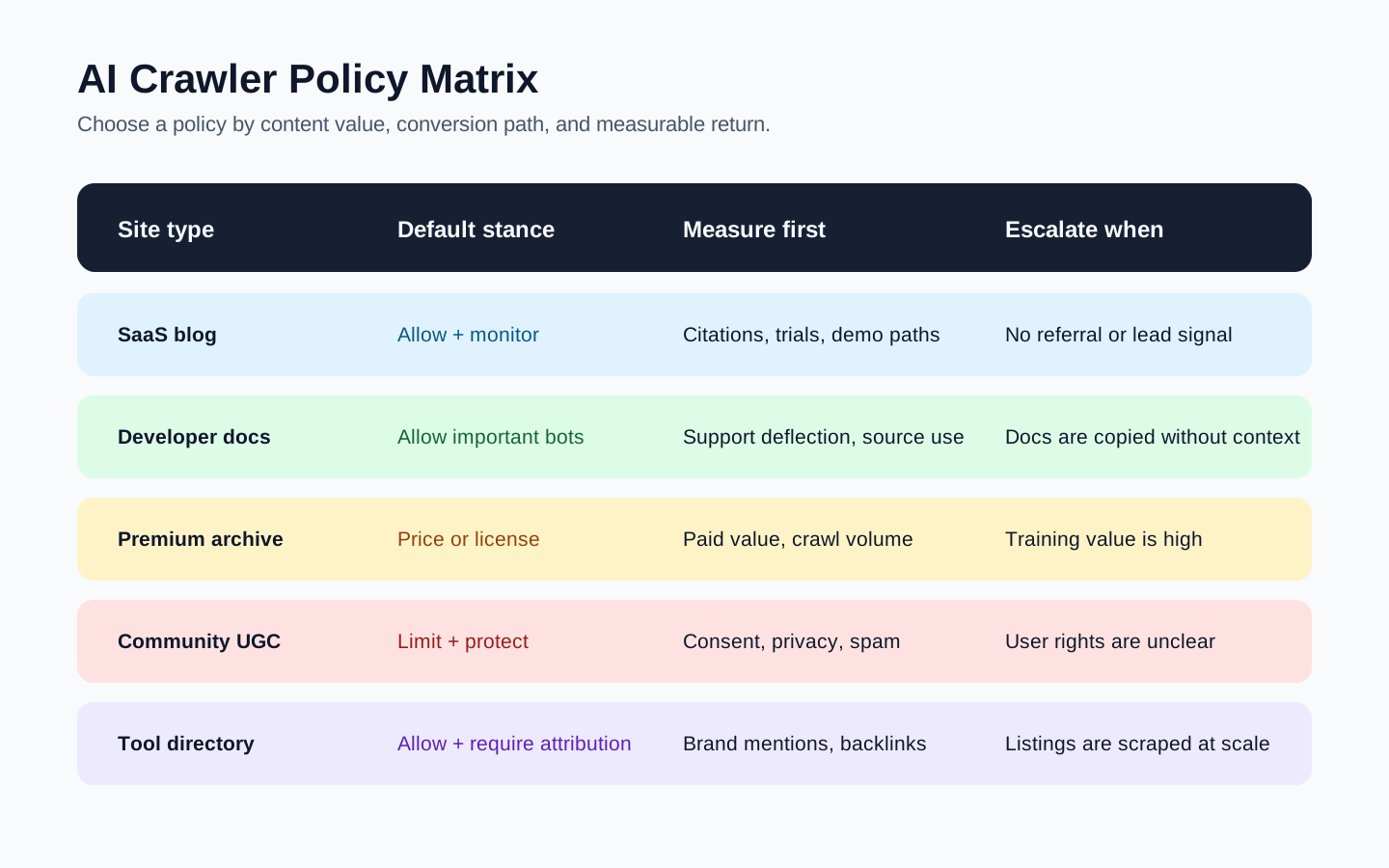
Crawler policy should begin with content type, not emotion. The same site may need several rules.
| Content type | Default posture | Why |
|---|---|---|
| Public SaaS blog posts | Allow and monitor | These pages exist to educate the market, create branded demand, and earn citations |
| Product documentation | Allow important discovery bots; monitor AI answer quality | Accurate AI answers can reduce support load, but outdated summaries can create product risk |
| Pricing pages | Allow Search; monitor AI summaries closely | Wrong pricing answers create conversion friction |
| Premium reports or paid archives | Limit, license, or price access | The content itself is the product, not only an acquisition asset |
| Community or user-generated content | Restrict until consent, privacy, and moderation rules are clear | The site may not own all reuse rights |
| Tool directories and comparison pages | Allow selectively; require attribution when possible | Discovery matters, but scraped listings can be copied at scale |
| Internal knowledge bases | Block at the access layer | Robots rules are irrelevant if the content should not be public |
The key is to avoid one global rule that treats a landing page, a pricing table, a paid report, and a community thread as the same asset.
Robots.txt is a signal, not a gate
Robots.txt is still useful. RFC 9309 defines it as a standard way for site owners to publish crawl preferences. It is the right place to express broad rules to cooperative crawlers.
But teams should not confuse a preference file with enforcement. Robots.txt does not authenticate a crawler, stop a scraper that ignores rules, protect paid content, or prove that a model did not use the page. If the content must be protected, use access controls, paywalls, rate limits, firewall rules, or bot management.
This is also why AI crawler policy should be owned by more than the SEO team. SEO can judge discovery risk. Engineering can enforce access. Legal or editorial teams can judge rights and licensing. Product marketing can judge whether AI answer visibility is useful.
A practical decision matrix
Use this decision matrix before changing rules.
| Question | If yes | If no |
|---|---|---|
| Is the page meant to acquire readers or customers? | Allow major discovery crawlers and measure citations | Consider limiting non-search AI crawlers |
| Does the page contain paid, private, licensed, or community-owned material? | Restrict access beyond robots.txt | Public crawl policy may be enough |
| Does AI answer visibility help the business even without a click? | Monitor mentions and citations | Focus on referral and conversion data |
| Can the team identify which bot is crawling? | Write bot-specific rules | Start with logging before blocking |
| Could blocking the wrong bot hurt Search? | Separate Search crawlers from AI product controls | Use conservative rules |
| Is crawl cost or server load meaningful? | Rate-limit or challenge heavy traffic | Avoid premature blocking |
| Is there a path to licensing or paid access? | Test price/permission models | Keep monitoring until value is clear |
The best first move is often not "block." It is "log, classify, and separate."
What small SaaS and content teams should do first
Small teams rarely need a complex AI crawler policy on day one. They need a baseline.
Start with five checks:
- List the public page groups: blog, docs, pricing, comparison pages, templates, directories, gated assets.
- Check server logs or bot analytics for major AI-related crawlers and unusual crawl volume.
- Test five to ten target AI search prompts and record whether your brand or URLs appear.
- Compare AI answer referrals, branded search, demo requests, newsletter signups, and cited URLs.
- Decide which page groups are acquisition assets and which are protected assets.
Only after that should the team write crawler rules. Otherwise the policy is based on anxiety, not evidence.
How this connects to GEO
Generative Engine Optimization is not only about making pages easier to cite. It is also about deciding which pages deserve to be part of AI answers.
For a SaaS company, allowing AI systems to discover comparison pages, documentation, glossary pages, and problem-solution articles may be useful. These pages can teach answer engines how the product category works. Blocking all AI crawlers may protect content, but it can also reduce the chance that the brand appears in answer surfaces.
For a paid research site, the opposite may be true. The free landing page should be discoverable. The expensive report archive should not be freely absorbed into third-party summaries. The policy should distinguish the marketing layer from the paid asset.
This is where crawler control and content refresh meet. If AI answers are citing an old page, update the page. If AI answers mention competitors but not your product, improve category pages and comparisons. If bots crawl heavily but no answer surface cites the site, treat that as a value-exchange problem.
The dangerous mistakes
The first mistake is overblocking. Some teams see AI crawlers in a dashboard and block broadly. If rules catch Googlebot, Bingbot, or important preview/rendering services, normal search visibility can suffer. Google-Extended is not Googlebot. GoogleOther is not the same as Googlebot. User-agent details matter.
The second mistake is underprotecting. If a site sells research, templates, data, code, or community access, public crawlability may leak the value of the product. A robots.txt line is not enough protection for paid assets.
The third mistake is measuring only clicks. AI search may influence branded demand without sending a clean referral. Teams should look at cited URLs, brand mentions, assisted conversions, branded search changes, sales questions, and support tickets. Clicks still matter, but they are no longer the only signal.
The fourth mistake is writing a permanent policy for a moving market. AI crawler behavior, product documentation, publisher tools, and legal expectations are still changing. A policy should be reviewed like a growth experiment, not carved into stone.
30-day AI crawler policy test
For most small teams, a 30-day test is safer than a dramatic rule change.
| Week | Work | Output |
|---|---|---|
| 1 | Inventory page groups and log crawler activity | Crawler baseline by page type |
| 2 | Run AI answer visibility prompts | Citation and mention snapshot |
| 3 | Apply narrow rules to one page group | Controlled policy change |
| 4 | Compare crawl volume, citations, referrals, conversions, and errors | Keep, adjust, or reverse decision |
The goal is not perfect control. The goal is knowing which policy helps the site.
Local-market notes
Multilingual sites should be careful with global rules. A Spanish, Indonesian, Vietnamese, Brazilian Portuguese, or Chinese page may have different search demand and fewer competing sources. Blocking AI discovery on those pages can remove one of the site's few early visibility channels.
At the same time, local community content often travels through WhatsApp, Zalo, Facebook Groups, Telegram, WeChat, LINE, or private forums. If that content was not created for broad reuse, it should not be treated like a public acquisition blog post.
For cross-border SaaS teams, the practical split is simple:
- Keep public explainers and product education crawlable where visibility matters.
- Protect user data, gated templates, paid reports, private community posts, and internal docs.
- Monitor whether AI answers cite the localized page, the English source, or a competitor.
- Refresh localized pages when answer engines keep using stale English-only explanations.
Related reading
- LLM Visibility: How Brands Are Found Inside AI Answers
- AI Answer Citation Checklist: What Makes a Page More Likely to Be Cited
- AI Search Content Refresh: How to Update Pages for Citations and Mentions
- AI Visibility Audit Workflow: A Manual Process Before You Buy Tools
- GEO Tools for SaaS Teams: What to Evaluate Before You Buy