AI Answer Citation Checklist: What Makes a Page More Likely to Be Cited
A practical checklist for making pages easier for AI answer engines to understand, verify, compare, and cite.
Last updated
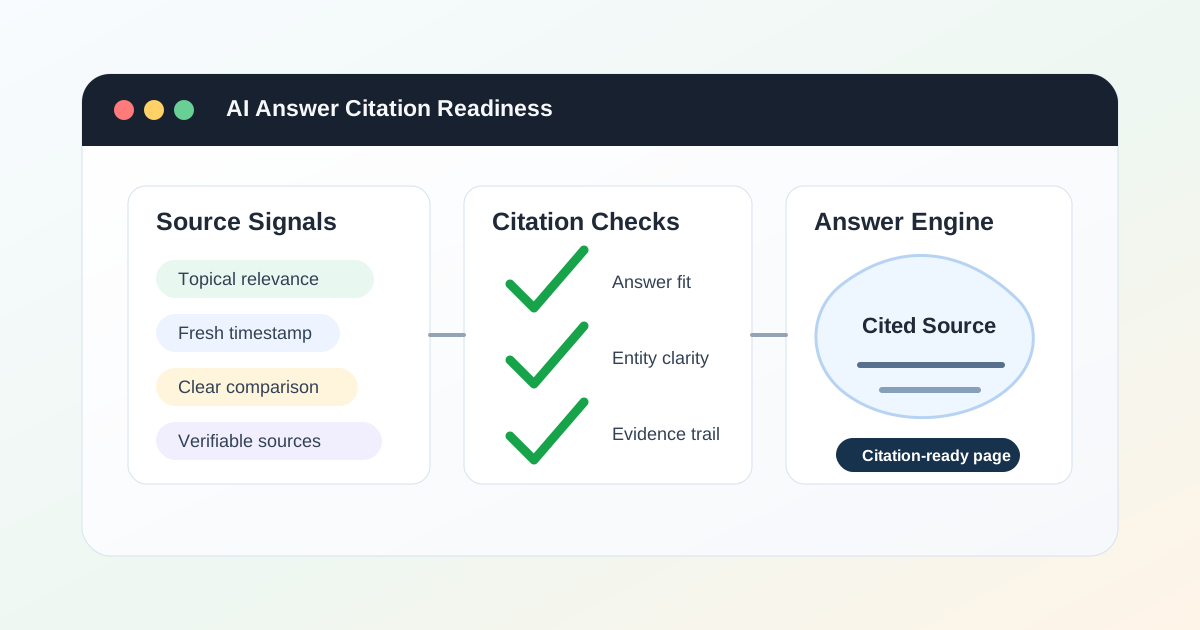
An AI answer citation is the moment an answer engine points to a specific page as a source. For a content site, that is different from simply being mentioned. A mention says the brand or idea appeared in the answer. A citation says the page was useful enough to be shown as evidence.
Traditional SEO asks whether a page can rank and earn clicks. AI search adds another question: when a system such as ChatGPT, Perplexity, Gemini, Copilot, or an AI search feature builds an answer, is this page clear enough to retrieve, compare, and cite?
The practical goal is not to trick an answer engine. It is to make the page easier for both humans and AI systems to evaluate: what the page is about, who it helps, what evidence it uses, when it was updated, and why it is a better source than a generic summary.
Why citation readiness matters
AI answer engines often work with more source material than they can show. A system may retrieve several candidate pages, summarize an answer, and cite only a few. That creates a second layer of competition after indexing and ranking.
The 2026 paper "What Gets Cited: Competitive GEO in AI Answer Engines" studied a controlled setting where answer systems chose between candidate sources. Its findings should not be treated as a universal ranking formula, but they are useful directionally: topical relevance and source position were strong drivers, while explicit price information and recent timestamps also helped in the tested setup.
For content operators, the lesson is simple. Citation readiness is not one magic tag. It is a stack of signals: relevance, clarity, evidence, structure, freshness, and usefulness.
Ranking is not the same as being cited
A page can rank for a query and still be a poor citation candidate. That usually happens when the page has a good title but weak source value.
| Page pattern | It may rank because | It may not be cited because |
|---|---|---|
| Broad concept summary | It matches the keyword | It lacks original examples, sources, and decision value |
| Thin tool list | It covers many product names | It does not explain criteria, trade-offs, or current status |
| Opinion post | It has a strong angle | It does not give verifiable details an answer can reuse |
| Old tutorial | It has backlinks or age | It may be stale for fast-changing software or AI workflows |
| Product landing page | It explains the brand | It may not answer the neutral question a user asked |
This is why AI citation work belongs near content quality, not only technical SEO. Crawlability, indexability, and structured data still matter, but they do not replace the page's actual usefulness.
What citation-ready pages have in common
Citation-ready pages make the answer engine's job easier. They are specific, current, structured, and verifiable.
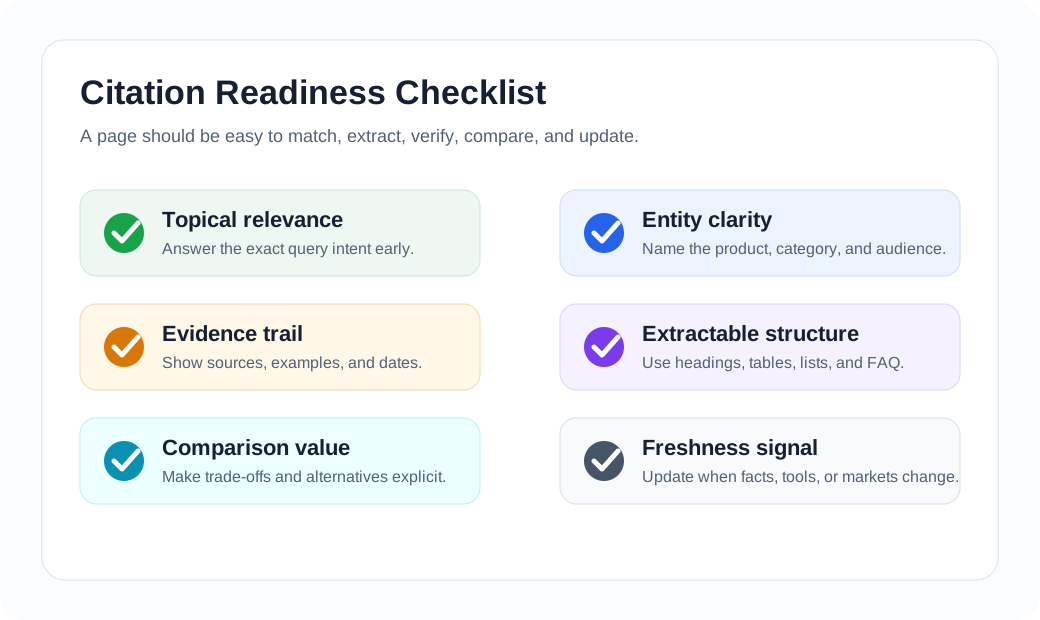
Use this checklist before calling a page ready for AI answer citations:
| Check | What to add | Why it helps |
|---|---|---|
| Topical relevance | A direct answer to the main query in the opening section | The page can be matched to a specific question quickly |
| Entity clarity | Clear names for the product, category, audience, and adjacent terms | The system can understand what the page is about |
| Evidence trail | Sources, examples, dates, product pages, or research links | Readers and answer systems can verify claims |
| Extractable structure | H2s, tables, checklists, FAQ, and short definitions | The page is easier to parse and summarize |
| Comparison value | Alternatives, trade-offs, "good fit / bad fit" language | The page becomes useful for recommendation-style prompts |
| Freshness signal | Updated date and a reader-facing update log | Fast-changing topics look maintained rather than abandoned |
The strongest pages do not just say "this is important." They show the reader what to check next.
A page-level citation audit
Run this audit on any article, tool page, or guide that you want answer engines to cite.
- Name the intent. Write the exact question the page should answer, such as "what are AI search monitoring tools?" or "how do I audit AI answer citations?"
- Check the first screen. The opening section should define the topic, name the audience, and explain why the page exists.
- Mark the reusable facts. Highlight definitions, comparisons, prices, dates, product limits, checklists, and examples that could safely appear in an answer.
- Inspect the evidence. Every strong claim should connect to an official source, product page, research paper, public documentation, or original example.
- Add a comparison block. If the topic involves tools, workflows, or strategy, include a table that helps a reader choose.
- Add FAQ. Use questions a reader would actually ask. Keep answers short enough to stand alone.
- Update the page. Add a reader-facing update log when the page changes materially.
- Link the cluster. Connect the page to related concept, tool, checklist, and multilingual pages.
The goal is to make the page a better source, not to inflate it. If a section does not help a reader understand or decide, it probably does not help citation readiness either.
How the source selection loop works
The exact mechanics vary by answer engine, query, and interface. Still, the content workflow can be simplified.
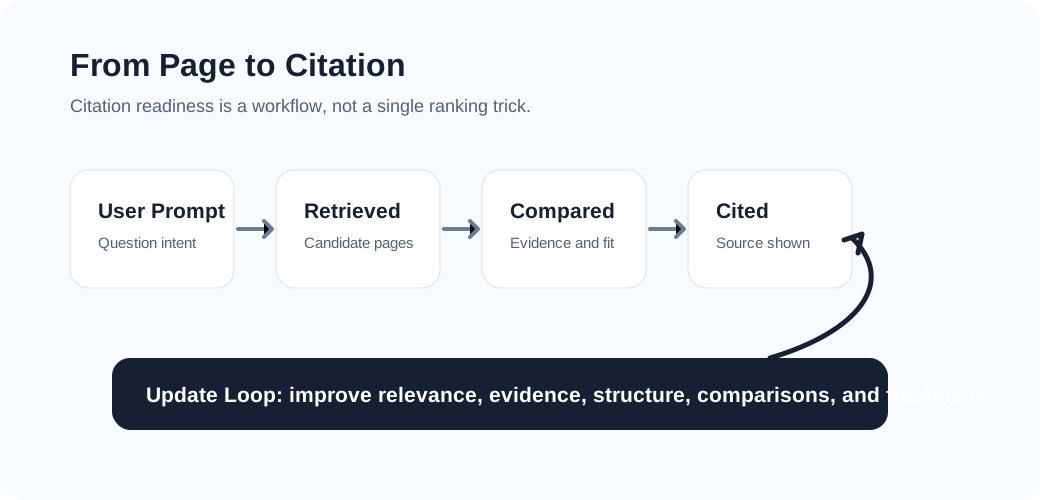
The loop has four content jobs:
- Match the prompt with clear topic language.
- Give the system extractable facts and comparisons.
- Show evidence that a reader can inspect.
- Keep the page current enough to remain useful.
This is where many AI search pages fall short. They define GEO once, then stop. A better page says what changed, how to check it, what tools or workflows matter, and which adjacent pages should be read next.
SaaS and B2B pages need extra clarity
SaaS and B2B pages are often written for conversion, not citation. That can make them harder for answer engines to use. A page may describe a product as "the intelligent platform for modern teams" without naming the category, use case, buyer, limits, pricing model, or alternatives.
For citation readiness, SaaS teams should add:
- a plain category definition
- the buyer and use case
- supported integrations, regions, and languages
- pricing model or a clear pricing caveat
- comparison criteria
- limitations and not-fit scenarios
- links to documentation, changelogs, and help pages
This does not mean turning every landing page into a long article. It means giving answer systems and human buyers enough precise language to classify the product accurately.
What not to over-optimize
Citation readiness can become noisy if teams chase every possible signal. Avoid these mistakes:
- adding tables with no decision value
- repeating the same keyword in every heading
- adding stale dates that do not reflect real updates
- citing weak sources just to make a page look sourced
- writing for a generic AI system instead of a real reader
- hiding product limitations because the page is too sales-driven
Google's guidance around AI features still points site owners back to durable search fundamentals: make content accessible, useful, and eligible for Search features. That is the right baseline. A page that is thin for a human is unlikely to become a strong AI citation source for long.
Multilingual citation readiness
The multilingual opportunity is not just translating a citation-ready English page. Local-language pages need their own search phrasing, examples, and questions.
For Indonesian, Brazilian Portuguese, Spanish, Vietnamese, and Chinese pages, check:
- Does the page use natural local terms for AI search, citations, and brand visibility?
- Are examples drawn from local SaaS, ecommerce, education, creator, or team workflows?
- Are tool availability, language support, and pricing caveats clear?
- Does the FAQ sound like a local reader, not a translated English checklist?
- Does the page link to related local-language pages in the same cluster?
The English article supplies the research spine. The local page has to earn trust in its own market.
Related reading
- LLM Visibility: How Brands Are Found Inside AI Answers
- AI Search Monitoring Tools: What to Track Before Buying One
- AI Search Content Refresh: How to Update Pages for Citations and Mentions
- Multilingual SEO Directories: A Practical Path for New Content Sites
- The Opportunity in Local-Language AI Explainers