Agentic Bots Are Reaching Your Funnel: A Practical Defense for SaaS Teams
A layered way to protect SaaS signup, trial credits, checkout, and API access from automated abuse without assuming every automated visitor is malicious.
Last updated
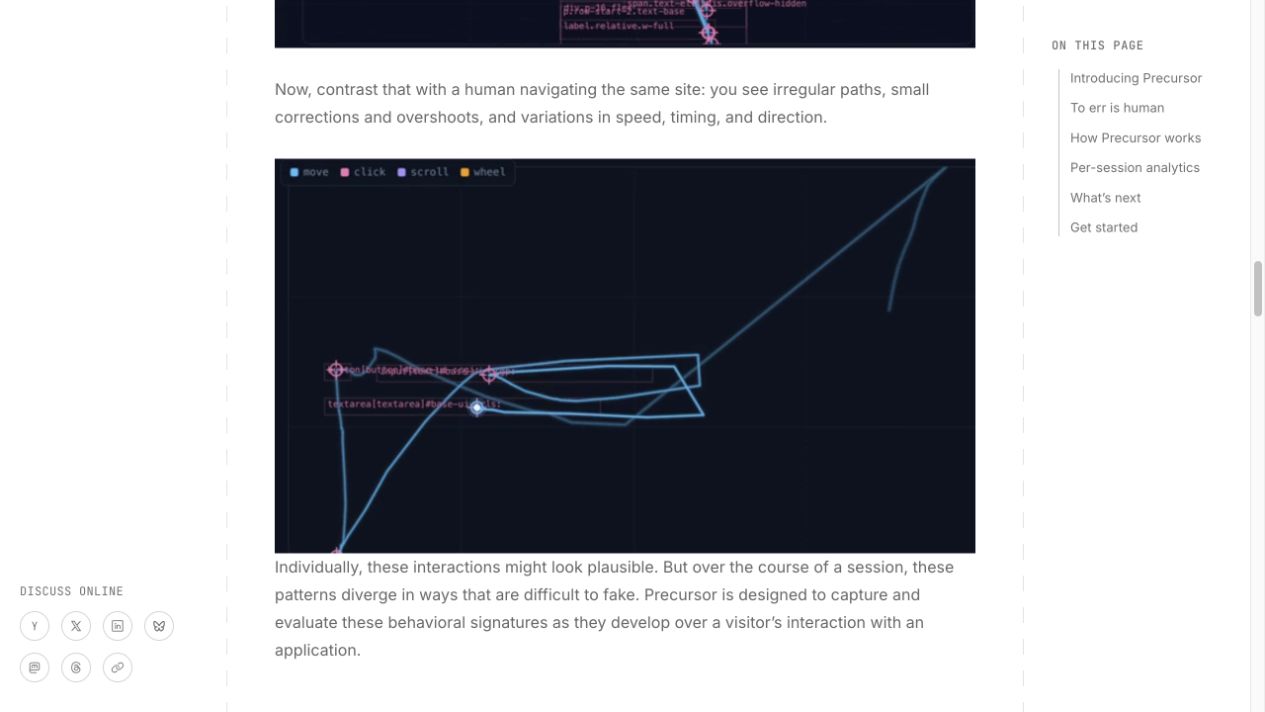
For a long time, SaaS abuse defenses were built around a simple picture: a person visits the site, and a bot hits an endpoint too quickly. That picture is no longer enough.
Modern automation can use a browser, execute JavaScript, fill forms, wait between actions, and return later. Some of it is malicious. Some of it is a user's legitimate agent completing work on their behalf. Some of it is a test, an accessibility tool, or an integration you actually want.
The practical response is not "block every bot." It is to protect the actions that create cost or irreversible risk, while measuring whether your controls harm real conversion.
Cloudflare's July 2026 Precursor announcement is a useful public signal of this shift. The product describes session-level, client-side behavioral signals as an additional layer for distinguishing human and automated behavior. Its premise is straightforward: a single checkpoint sees only one moment; a funnel sees a pattern over time. Whether or not a team uses that product, the operating lesson travels well.
Your landing page is not the part that usually hurts
Most teams start with a login page because it is visible. The expensive abuse often begins later:
- a new account claims free credits and immediately runs expensive jobs;
- a generated trial uses a disposable email, then creates another account;
- a checkout is probed with stolen cards or fake payment attempts;
- an API token is created and used to exhaust a shared quota;
- a workflow changes customer data before anyone can verify who initiated it.
Each stage has a different loss function. A public landing page can tolerate a large amount of automated traffic. A trial that grants $5 of model usage cannot. Treating both with the same CAPTCHA rule is a poor allocation of friction.
Map the funnel before choosing a vendor
Draw the path from first request to the most expensive action. For each step, answer four questions:
- What can the visitor gain here?
- What can this step cost us if repeated 1,000 times?
- What information can we verify without collecting more than we need?
- What is the least disruptive control that reduces the relevant risk?
The result often looks like this:
| Funnel step | Main risk | First control | Escalation control |
|---|---|---|---|
| Landing and docs | scraping, scanning, noisy traffic | caching, rate limits, observability | managed challenge for clearly abusive patterns |
| Signup | account farming, fake identities | velocity limits, email checks, delayed privilege | risk-based verification or manual review |
| Trial credit | expensive compute abuse | small initial allocation, per-action caps | payment or stronger verification before expansion |
| Checkout | card testing, fraud | payment-provider signals, attempt limits | step-up verification and support review |
| API and account changes | quota exhaustion, data access, destructive actions | server-side auth, scoped permissions, idempotency | anomaly detection, temporary holds, human approval |
The table is not a replacement for a security review. It makes the review specific. It moves the conversation from "do we need bot protection?" to "which action is currently uninsured?"
Why a single CAPTCHA is not a complete strategy
CAPTCHAs and managed challenges are still useful. Cloudflare's Turnstile documentation positions the product as a way to protect forms and user interactions without a traditional visual puzzle. A challenge can raise the cost of basic automation and reduce obvious abuse.
But it is only one signal at one point in time.
Cloudflare's Precursor announcement argues that sophisticated automation can use real browsers, run JavaScript, and pass isolated checks. It proposes observing session behavior such as timing, focus, visibility, and interaction patterns instead. The specific implementation is vendor technology, and the product was described as rolling out ahead of general availability. The broader design principle is less controversial: do not rely on one event when the abusive behavior appears across a sequence of events.
For a product team, that means combining controls:
- rate-limit by the action that consumes money, not only by IP address;
- issue a small trial allowance before a high-cost action becomes available;
- require server-side authorization for every sensitive route;
- make retries idempotent so a loop cannot bill or mutate state repeatedly;
- log the chain from signup to costly action, with a privacy-conscious retention policy;
- allow a person to recover from a false positive.
Start in shadow mode
The fastest way to hurt a new SaaS funnel is to add strict challenges before you know who you are blocking. Begin by observing.
For one or two weeks, log signals around the three most expensive actions. Measure account age, action velocity, credit consumption, payment attempts, task failures, and support outcomes. Do not collect raw interaction content simply because a vendor can expose a signal; collect the minimum data needed to evaluate the pattern and meet your privacy obligations.
Then label a small sample. Which accounts were clearly abusive? Which were real customers with unusual behavior? Which were automated but permitted? Which cases are ambiguous? This gives your team a false-positive baseline before it starts gating traffic.
Shadow mode also helps separate a security problem from a product problem. If new trial accounts consume expensive credits but never reach an activation event, the remedy may be a narrower free tier rather than a more aggressive challenge. If valid users abandon because an email verification arrives late, the fix may be delivery reliability rather than fraud scoring.
Give each control an owner and an exit condition
Controls accumulate. A rate limit is added after an incident. A CAPTCHA appears after another. A payment hold is added after a fraud spike. Six months later, nobody knows why the funnel is difficult.
For every new defense, record:
- the abuse pattern it is meant to reduce;
- the action and audience it covers;
- the expected cost reduction;
- the conversion or accessibility risk;
- the owner who reviews it;
- the condition under which it will be relaxed, replaced, or removed.
This is the same discipline that makes AI Agent Security Checklist: Review Tools, Prompts, and Data Before Delegating Work useful. Security is not a list of scary terms. It is a decision about permissions, failure modes, and the smallest safe scope.
Do not confuse bot detection with authorization
Even excellent bot detection cannot decide whether an action is allowed. A human account can be compromised. A trusted integration can request too much. A legitimate agent can be asked to perform a destructive task without the right approval.
Keep authorization on the server. Scope credentials. Put limits around credit-consuming routes. Confirm state-changing actions. Store an audit trail. Use bot and behavioral signals as inputs to a risk decision, not as a substitute for product permissions.
That distinction matters for agents especially. Your future customer may ask an agent to sign up, compare plans, or fetch an API result. The product should be able to permit that useful action while still refusing unlimited free compute, unverified account changes, or suspicious payment behavior.
A practical 30-day sequence
Week one: map the funnel and calculate the top three losses from abuse or failed verification.
Week two: add action-level limits, smaller initial credits, idempotency, and logs. Keep friction low while you observe.
Week three: review sampled patterns and introduce risk-based escalation only where the loss justifies it.
Week four: compare prevented loss, false positives, signup-to-activation conversion, support tickets, and the cost of the controls. Keep, tune, or remove the weakest layer.
This is slower than installing a single widget, but it makes the security decision legible. It also lets a small team protect its margin without deciding that every unfamiliar visitor is an attacker.
Related reading: AI Agent Security Checklist: Review Tools, Prompts, and Data Before Delegating Work, Keyword Scout, and Pricing.
Related insights
All insights
llms.txt Generator: Build a Reviewed Site Guide, Not an AI Ranking Shortcut
What an llms.txt generator should create, how to select and review its pages, and why the file is useful site documentation rather than a guaranteed AI ranking tactic.
Read insight
AI Agent Security Checklist: Review Tools, Prompts, and Data Before Delegating Work
A practical checklist for reviewing AI agent tools, prompts, data boundaries, permissions, and logs before letting agents take action.
Read insight
GEO Tools for SaaS Teams: What to Evaluate Before You Buy
A practical evaluation guide for SaaS teams comparing GEO, AI visibility, and answer-engine optimization tools.
Read insight