AI Search Visibility for Content Sites: Diagnose Missing AI Citations
A source-led diagnostic for finding why content pages are absent, misrepresented, or replaced by competitors in AI answers.
Last updated

AI search visibility is the discipline of checking whether an answer system can accurately find, describe, link to, or cite your site when a reader asks a relevant question. It is not a new ranking metric and it is not a promise that every mention produces a click. For a content site, it is an evidence trail that connects a real question to a specific page you can improve.
That distinction matters. A conventional rank report can tell you that a URL ranks for a phrase. It cannot tell you whether an answer about the category treats your product as an alternative, cites an outdated guide, relies on a competitor's comparison table, or ignores the local-language version of the page entirely.
Google's guidance is useful here because it removes a common distraction. AI Overviews and AI Mode do not require special AI markup or a separate technical trick. Google says normal Search fundamentals still apply: the page must be indexed and eligible for a snippet; important content needs to be available as text; internal links and page experience still matter. Search Console reports traffic from Google's AI features inside the normal Web search type, not in a separate AI dashboard. That means the practical work is still content quality, technical eligibility, and measurement. The audit adds a way to observe the answer layer.
This guide is for content sites, SaaS teams, developer-documentation owners, and multilingual publishers that need to diagnose a page-level content gap before they buy a monitoring tool or rewrite their whole library. It complements the AI Visibility Audit Workflow: that guide explains how to run a brand-level baseline, while this one explains how to turn a saved answer into a focused content decision. The observations in this guide were reviewed on July 12, 2026. Treat answer outputs as snapshots: engines, indexes, links, and query wording can all change.
What an AI search visibility audit can and cannot prove
An audit can show patterns. It cannot prove causation after a single test.
| Question | What the audit can show | What it cannot show |
|---|---|---|
| Does our page appear? | Whether the site, brand, or URL is present in a saved answer | A permanent ranking or citation guarantee |
| Does the answer cite a competitor? | The current comparison set and the type of page being used | That copying the competitor will create the same result |
| Did a refresh help? | A before-and-after change for the same prompt, language, and engine | That the edit alone caused every change |
| Does local content matter? | Whether local prompts surface local pages, English sources, or competitors | That a translated page will work without local evidence |
| Are clicks improving? | Whether Web traffic, conversions, or branded demand move with the observation window | The exact portion attributable to an AI answer |
This guardrail prevents the usual mistake: treating one answer screenshot as proof that a strategy works. The useful output is not a visibility score. It is a prioritized list of pages, claims, comparisons, and local gaps that a team can validate.
Start with a question inventory, not a brand prompt list
Teams often begin by searching their company name in several answer engines. That is useful for brand monitoring, but it is a weak content audit. A reader rarely begins with your brand. They start with a job, category, alternative, constraint, or local question.
Build a question inventory around the decision your pages are supposed to support.
| Query family | Example prompt | Page type that should help | What to inspect |
|---|---|---|---|
| Definition | "What is AI search visibility?" | Concept or glossary page | Is the definition accurate and attributable? |
| Comparison | "AI search visibility vs SEO" | Difference table or explainer | Are boundaries and trade-offs clear? |
| Tool evaluation | "What should a SaaS team track before buying an AI visibility tool?" | Evaluation guide | Does the answer use explicit criteria or vague lists? |
| Alternative | "What are alternatives to X for AI search monitoring?" | Comparison page | Which features and competitors set the frame? |
| Workflow | "How can a small team audit AI answers manually?" | Checklist or process page | Is there a real step-by-step procedure? |
| Local market | "How should a Brazilian SaaS monitor AI citations?" | Localized guide | Does the engine use local sources and local phrasing? |
| Risk | "Should a content site block AI crawlers?" | Policy or decision matrix | Does the answer distinguish content types and controls? |
For each topic, choose five to ten prompts. Keep the wording fixed for at least one audit cycle. Add one or two discovery prompts separately, but do not mix them into the baseline. A changing prompt set creates changing results that cannot be compared.
Questions should represent the buying and learning journey
The prompt inventory should not be a keyword list in disguise. A strong set moves from explanation to decision:
- What is the concept?
- What is it not?
- Which options exist?
- What would make one option a better fit?
- What should the reader do before acting?
That sequence exposes the pages answer systems need: definitions, contrast tables, selection criteria, limits, and implementation checks. If a site only publishes definition pages, the audit will tend to show that competitors own the comparison and action stages.
Create an evidence record that another editor can reproduce
Do not write "we showed up in ChatGPT" in a report without keeping the prompt and answer. An audit needs enough detail for a second editor to repeat the check later.
Use a spreadsheet or database with one row per prompt result.
| Field | Required value | Why it changes the interpretation |
|---|---|---|
| Observation date and time | Exact timestamp and time zone | Answers and indexes can change |
| Answer engine and access mode | Product name, signed-in state if relevant, region if known | Results and available features differ |
| Exact prompt | Copy the question without editing | Small wording changes can change the answer |
| Language and market | For example es-MX, pt-BR, ja-JP | Local results cannot be inferred from English |
| Full answer capture | Text export, screenshot, or both | A score cannot show framing or omissions |
| Brand mention | Exact wording and position | "Listed" is not the same as "recommended" |
| Linked or cited URLs | URL, page type, and publisher | Reveals the evidence pattern |
| Competitors or alternatives | Names and claims attached to them | Shows the category frame readers receive |
| Missing element | Definition, source, table, example, FAQ, risk, or workflow | Converts observation into a content task |
| Proposed action | One page-level change with an owner | Prevents dashboards from becoming passive reports |
Save raw evidence rather than an interpretation alone. ChatGPT Search can display source links for answers, while Google AI features can surface links differently depending on the query and product. The visible answer is the record you can inspect; do not assume every engine exposes the same kind of citation.
Separate three signals that teams often blend together
The phrase "AI visibility" is too broad for decision-making. Split the audit into three tracks.
| Track | Main question | Primary evidence | Typical action |
|---|---|---|---|
| Answer presence | Is the brand or concept mentioned? | Saved answer and wording | Improve category positioning and core explanations |
| Source presence | Is a specific page linked or cited? | URL, page type, source placement | Improve sources, structure, and page completeness |
| Business contribution | Does this visibility help the business? | Web traffic, conversions, branded demand, sales/support feedback | Improve the conversion path or stop prioritizing the page |
These signals can move independently. A brand can be mentioned without a link. A page can receive a link but send no useful conversion traffic. A localized page can fail to appear while the English source is cited. Treating all three as one number creates poor decisions.
Google's own measurement guidance is a good reminder: AI feature traffic is reported within the Search Console Web search type, and teams should combine that view with conversion and engagement data. The audit record does not replace analytics. It tells you where to look.
Diagnose the result before editing a page
Do not respond to every missing citation by adding more words. First identify the failure mode.
| Observation | Likely issue | Validate before editing | Useful page change |
|---|---|---|---|
| Answer defines the topic but does not use your page | Your page is not a distinct source | Compare first paragraphs, sources, and table structure | Add a concise definition, primary evidence, and a difference table |
| Competitor is named as the default | Category framing favors the competitor | Inspect what claim, proof, or use case the answer attaches to it | Publish a fair comparison with fit and non-fit cases |
| Wrong product claim appears | Public pages are ambiguous or stale | Check docs, pricing, FAQs, and crawler access | Update primary product page and add explicit boundaries |
| English page appears for a local prompt | Local page is too thin or disconnected | Compare localized title, facts, internal links, and FAQ | Add local workflow, terminology, facts, and same-language links |
| Page is linked but does not convert | Landing experience does not match the question | Review message, CTA, source context, and analytics | Align the opening, proof, and next action with the prompt |
| No relevant pages appear | The site lacks the necessary content type | Map question to current cluster | Build the missing comparison, checklist, or documentation page |
This is where original judgment matters. A generic "add FAQs" recommendation is not enough. The audit should name the exact reader question, the missing evidence, the page owner, and the expected recheck.
Run a 30-day baseline before buying a monitoring platform
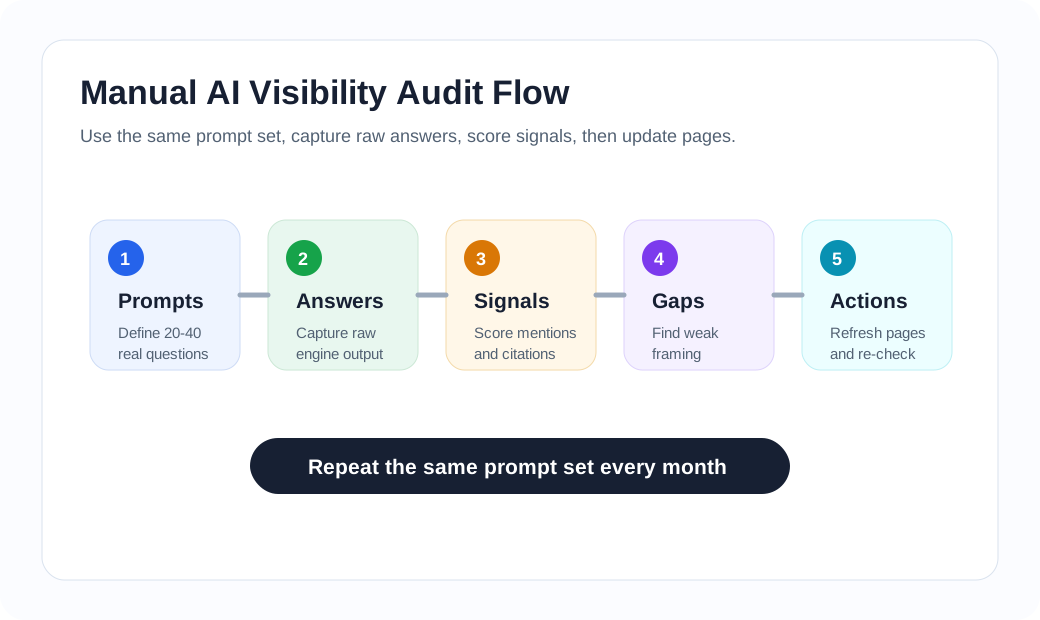
A small team can learn a lot with one month of structured manual work.
| Week | Work | Deliverable | Decision gate |
|---|---|---|---|
| 1 | Define topics, competitors, markets, and 5-10 fixed prompts per topic | Prompt inventory and evidence sheet | Remove vague prompts |
| 2 | Capture answers in target engines and languages | Baseline answer, source, and competitor record | Identify the three highest-value gaps |
| 3 | Update one page or create one missing page type per gap | Page-level change log with source evidence | Do not change many variables at once |
| 4 | Repeat the same prompts and review Web traffic, conversions, and feedback | Before/after comparison and next experiment | Keep, revise, or stop the hypothesis |
The first audit is intentionally manual because it teaches the team what a paid tool would need to track: prompt governance, locale handling, raw-answer access, citations, export, competitor setup, and history. Buying software before this baseline often creates a dashboard full of prompts nobody owns.
Multilingual audits need different questions, not translated screenshots
Multilingual teams make two common errors. The first is testing only English and assuming the result applies everywhere. The second is translating an English prompt word for word and treating the result as local research.
Both lose the market signal. A Japanese buyer may ask about approval workflows and enterprise support. A Brazilian operator may ask about WhatsApp, local payment, or Portuguese documentation. An Indonesian ecommerce seller may ask about marketplaces and customer-service workflows. A Spanish SaaS buyer may frame the query around country, compliance, price, or implementation support.
For every market, include:
- one definition prompt using the market's natural term
- one workflow prompt tied to a local channel or operating constraint
- one alternative or purchase prompt
- one question that exposes trust, pricing, privacy, or support concerns
- one query that checks whether the local URL, rather than the English source, is used
Google's multilingual guidance still applies: localized versions need to be discoverable and understandable as distinct language or regional pages. An AI answer audit adds a practical question: does the local page actually carry enough evidence to be a useful source when the reader asks locally?
Failure modes that create misleading reports
Checking too few prompts
One brand query can look good while every category and comparison query ignores the site. A valid baseline needs a small but varied prompt set.
Changing prompts, pages, and engines at the same time
If the prompt wording changes, the product changes, and several pages are rewritten in one week, the next answer proves almost nothing. Preserve one controlled comparison.
Treating links as the only outcome
Links are valuable, but they are not the whole business case. Some questions create awareness; some create source exposure; some produce a qualified visitor. Keep those goals separate.
Optimizing for an answer screenshot instead of the reader
Google's guidance is explicit that there is no special optimization required for AI features beyond normal eligibility and helpful, reliable content. The durable response is to make the page better for the reader: clear text, accessible facts, accurate public information, internal links, useful visuals where applicable, and a trustworthy next action.
Publishing thin localized summaries
A 250-word translation with one generic table may technically create a route, but it does not create a source worth citing. It also gives editors no way to learn why the local answer changes. Keep the source's facts and decisions, then add local examples and questions.
The audit output: a content backlog, not a vanity report
At the end of each cycle, convert evidence into a small backlog.
| Priority | Page | Evidence | Change | Recheck |
|---|---|---|---|---|
| High | Comparison page | Competitor cited for a claim we also make | Add primary source, fit matrix, and non-fit cases | Same prompts after recrawl window |
| Medium | Local guide | English source appears for a local-language query | Add local workflow, FAQ, and internal links | Local prompt set |
| Medium | Product page | AI answer uses an old pricing claim | Update pricing source and visible date | Pricing and alternative prompts |
| Low | Glossary page | Brand mentioned but definition is incomplete | Tighten first paragraph and add related links | Definition prompt |
The backlog should have an owner and a reason. "Improve AI visibility" is not a task. "Add an explicit API rate-limit table to the developer guide because the answer cites a competitor for that constraint" is a task.
A sensible tool-buying threshold
Consider a monitoring platform after the team can answer all of these questions:
- Which twenty to fifty prompts matter?
- Which answer engines and countries matter?
- Which competitors belong in the comparison set?
- Who owns each page-level change?
- Which business metric makes a visibility change worth acting on?
- Do we need raw answers, source URLs, historical snapshots, exports, or alerts?
Without those answers, a tool may create a polished report but little operational learning. With them, software can reduce manual collection and make a monthly workflow repeatable.