x402 Agent Payments: What Small API Products Should Test Before Charging Per Call
x402 makes an agent-paid API call easier to imagine, but small SaaS teams still need a price, identity, limit, ledger, and fallback before they call it a business model.
Last updated
An agent paying for an API call sounds like the cleanest possible SaaS motion: no sales call, no trial nurture, no checkout form. A request arrives, sees a price, pays, and receives a result.
That is a useful product idea. It is not yet a product model.
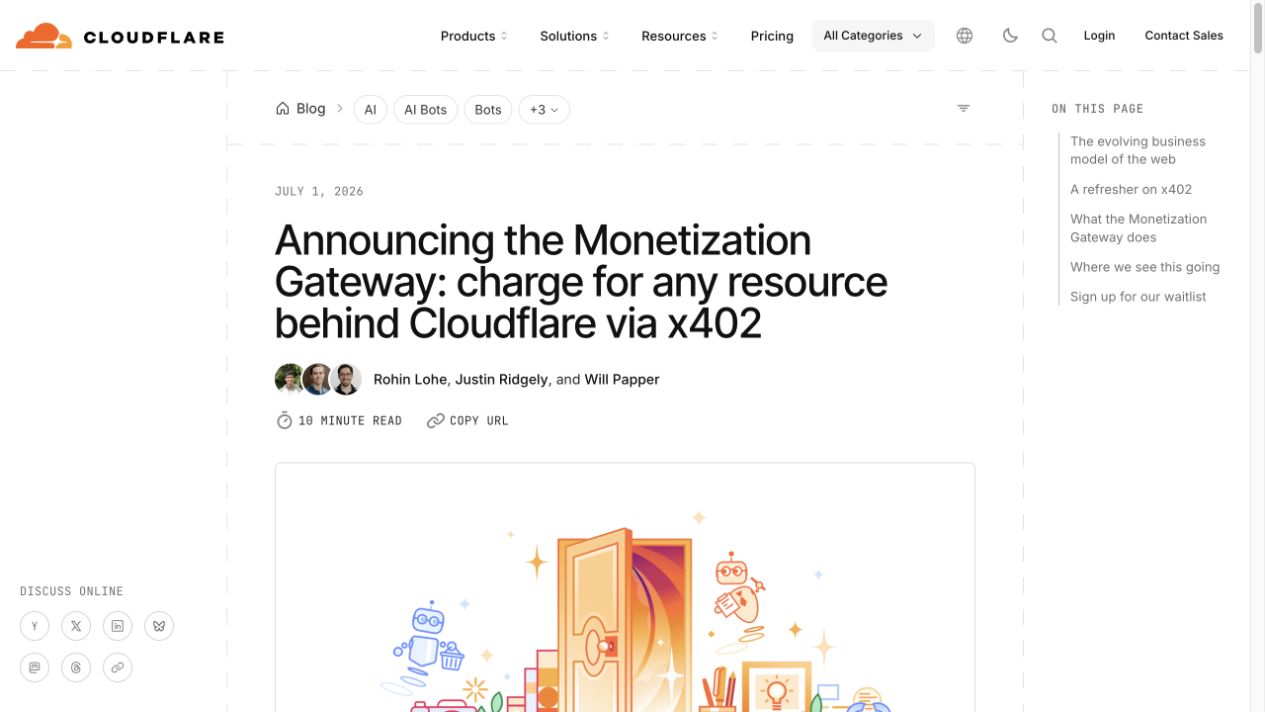
Cloudflare's July 2026 announcement of a Monetization Gateway built around x402 put this question in front of more API and MCP-tool builders. The company describes a path for charging for a web page, dataset, API, or MCP tool when a request reaches its network, with a waitlist open for the product. Its examples include paid REST routes, variable prices for expensive work, and tool calls made by agents.
The signal is real: an agent can become a buyer for some digital work. The mistake is assuming a payment protocol removes the rest of the work of selling access.
The useful question is not "can an agent pay?"
The useful question is: which request becomes better when a buyer can pay without first becoming an account?
For a small product, that is usually a bounded job with a visible output and a nontrivial marginal cost. Examples include:
- enriching one company record with a defined set of fields;
- producing a one-off export from a public dataset;
- running a scoped document conversion or image job;
- calling an MCP tool that completes one specific research or transformation step;
- unlocking a high-cost API route after a free preview has shown the shape of the result.
Those are very different from "let agents pay for everything." A customer may still need a workspace, a history of previous work, team permissions, recurring limits, invoices, or human support. An API key may still be the better interface for a developer who needs predictable monthly volume.
The agent-paid route is strongest when it removes a one-time access hurdle. It is weak when it tries to hide an ongoing customer relationship behind a per-request invoice.
What the x402 signal actually changes
HTTP 402 has existed for a long time as a status code reserved for payment-related use. The current x402 work gives builders a more concrete way to describe a request that needs payment before it proceeds. Cloudflare's announcement frames its gateway as an enforcement point: a request matches a rule, payment is verified, and only then can the request reach the origin.
That is infrastructure, not proof of demand.
The new option matters because it turns a familiar product question into a testable flow:
| Old question | Testable version |
|---|---|
| Would someone pay for this API? | Does a high-intent caller complete one paid, bounded request? |
| Should this be a subscription? | Does repeat usage justify an account, history, and a recurring plan? |
| Can an agent use the tool? | Can the tool state its price, limits, result format, and failure behavior clearly enough for software to call it? |
| Is the route valuable? | Does the customer accept the output without a costly support or refund loop? |
This is why small teams should think of x402 as an experiment surface, not a replacement for billing architecture. It can reveal whether a specific action has standalone value before the team builds a full self-serve funnel around it.
Five layers that still belong to the product team
The diagram above is deliberately less glamorous than "agent commerce." A paid request still needs five decisions.
1. Price: quote the unit a buyer can understand
Do not price a hidden internal unit such as tokens, model calls, or queue time unless the buyer can predict it. Price the useful unit: one verified record, one completed export, one generated asset inside a stated size limit, or one accepted report.
Variable pricing can be appropriate when compute truly varies, but it needs a ceiling. A caller should know the maximum charge before it triggers a task. If the price cannot be explained in one sentence, it is probably too early to automate the purchase decision.
2. Identity: payment is not authorization
Someone paying for a request does not answer who is making it, which user they act for, whether they are allowed to access the target data, or whether their prior behavior is trusted. Cloudflare's Web Bot Auth documentation is useful context here: verified automation and payment are related trust signals, not the same thing.
For a public data lookup, a lightweight identity may be enough. For a customer-data action, document conversion, or account-changing tool, a payment-only flow is usually insufficient. Keep server-side authorization separate from the payment handshake.
3. Limits: every paid route needs a failure budget
Chargeable endpoints attract accidental loops as well as deliberate abuse. Give each route a hard limit on input size, retries, concurrency, spend, and output size. Return a machine-readable explanation when the request cannot proceed.
This matters even for honest agents. A planner can retry a failed step several times. A model can choose an overly expensive branch. A human may be surprised by a tool that keeps spending after the first acceptable result. A budget ceiling protects the buyer and your gross margin at the same time.
4. Ledger: make the request auditable
You need more than a successful payment callback. Keep a record of the quoted price, identity or payment reference, idempotency key, route, input class, result status, and refund decision. Without that ledger, support cannot answer a simple question such as "what did we charge for, and did the job finish?"
The ledger is also how you learn whether the route is a real product. Count successful, accepted tasks, not merely paid attempts. If a paid request repeatedly creates support tickets or refunds, the route may be technically monetizable but commercially wrong.
5. Fallback: agent-first must not mean human-hostile
An API should expose a clear fallback for a person. That can be a normal checkout page, a trial credit, a contact path, or a documented API-key plan. Some buyers will not use the proposed payment rail. Some will need an invoice. Some will want a long-running relationship rather than a one-off purchase.
Treat the agent-paid path as one door into the product, not the building.
A two-week experiment that will tell you something
Pick one route that already meets all four conditions:
- It solves a narrow job with an objectively delivered output.
- It has a cost or abuse risk worth controlling.
- It can return a result or failure quickly.
- It does not expose private customer data without an existing authorization layer.
For two weeks, create a controlled offer around that route. Set a clear maximum price, an idempotency key, a daily spend ceiling, a visible task status, and a human fallback. Do not redesign the whole pricing page yet.
Track five numbers:
- qualified requests that saw the price;
- payment attempts that completed;
- jobs that completed technically;
- outputs accepted without manual support;
- contribution after compute, payment, and support cost.
The last two are the decision metrics. Ten paid requests that need manual repair are weaker evidence than three requests that finish, get reused, and lead a buyer to a recurring plan.
When not to use an agent-paid request
Avoid this route when the real value is ongoing collaboration, when the output needs heavy human interpretation, or when the action can materially change a customer's account. It is also a bad first move when you cannot state the unit price or cap the loss from a bad call.
Do not use the protocol as a shortcut around compliance either. Payment availability, stablecoin treatment, tax, customer verification, and local restrictions vary by buyer and market. Cloudflare's July announcement described an initial stablecoin-oriented direction and a waitlist, not a universal payment solution. Check current availability and legal requirements before shipping a production flow.
The opportunity is a better product boundary
The interesting part of x402 is not that every agent will suddenly buy every API. It is that builders can isolate a valuable operation, attach a transparent price, and learn whether that operation deserves a deeper product relationship.
Start with one costly, useful action. Keep authorization, budgets, logs, and fallback in the design. If the request works repeatedly, you have evidence for a plan, a workspace, or a higher-value tool. If it does not, you have learned before turning a protocol announcement into a roadmap.
Related reading: AI Tool Ideas: Find Repeated Work Worth Building Before You Build an Agent, Context Engineering: The Layer Between Prompts and Reliable AI Products, and Tools.
Related insights
All insights
AI Tool Ideas: Find Repeated Work Worth Building Before You Build an Agent
A research method for turning repeated user work into a narrow, testable AI tool with a clear input, output, evidence rule, and validation plan.
Read insightThe Opportunity in Local-Language AI Explainers
Many emerging AI terms are still under-served outside English, creating room for useful localized content.
Read insight